UK vs Portugal electrics: what is different, and why
Published by FuturePower PT, electricians with 20+ years in the UK, now in Portugal
If you have moved from Britain to the Algarve, or you are buying a house here, the electrics will look familiar and behave differently. We spent more than two decades wiring homes under the British rules and now work every day under the Portuguese ones, so here is the honest comparison: what is the same, what is different, and what it means for you.
Both countries run at 230 V, 50 Hz and both follow rules descended from the same international standard, so your appliances work and the safety principles match. The big practical differences are the plug, the way sockets are wired (ring versus radial), a supply sold in capacity tiers that trips when you exceed them, a different earthing arrangement that leans on RCDs, sockets in bathrooms, and paperwork with different names.
The short version for a buyer: ask what the contracted power is, whether every circuit sits behind a 30 mA RCD, and whether the house has its own earth rod. For someone moving over: change the plugs on what you brought, and expect no electric shower.
Same voltage, different plug
The UK and Portugal are both on the harmonised European supply of 230 V at 50 Hz. In practice a British home often measures nearer 240 V and a Portuguese one nearer 230 V, but every appliance sold in either country is built for that whole range. A kettle, a fridge, a washing machine or a television bought in the UK runs normally here.
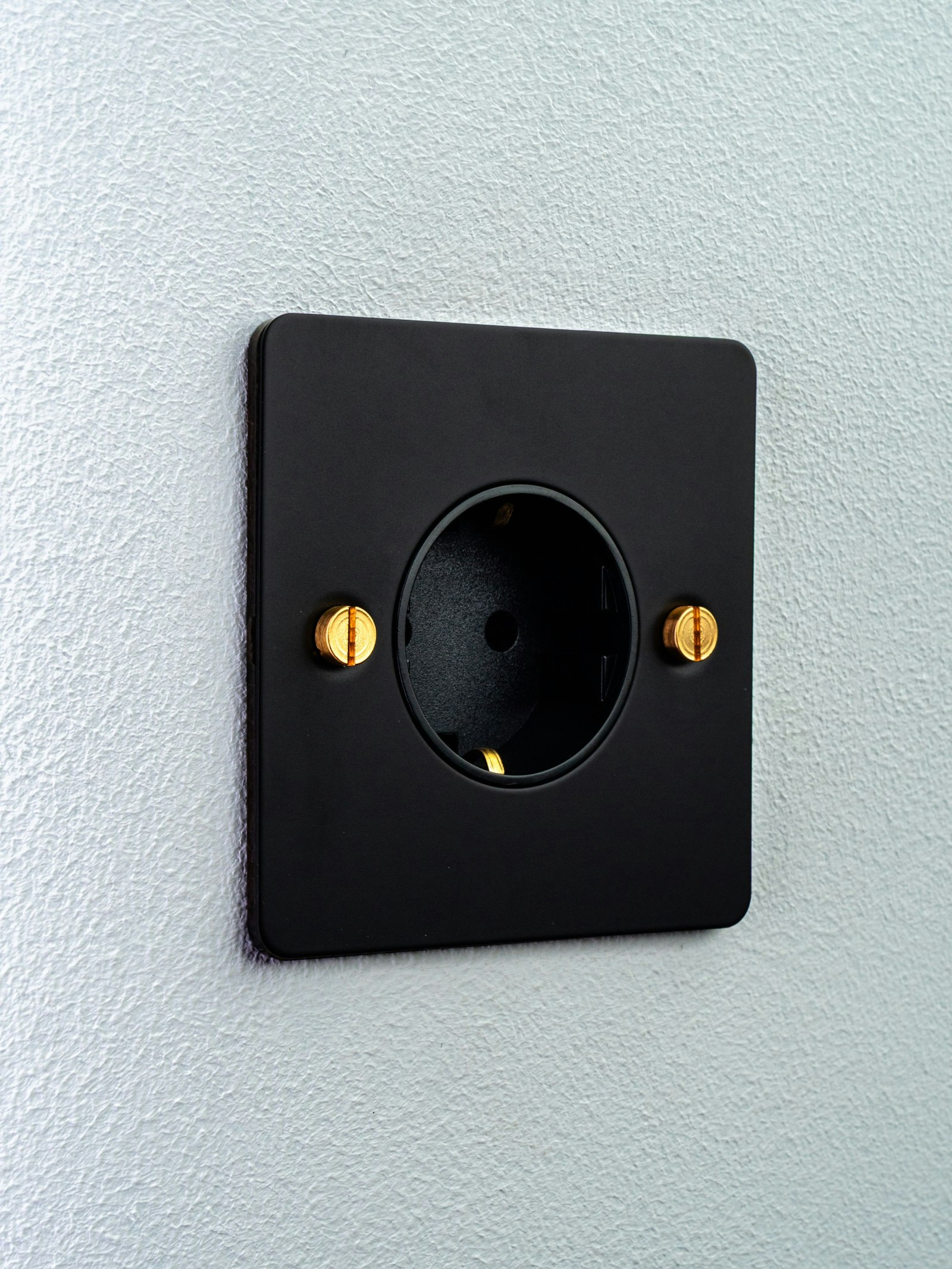
What changes is the socket. Britain uses the BS 1363 three-pin plug, with a fuse inside the plug, shutters on the socket and usually a switch beside it. Portugal uses the Schuko socket (type F, sometimes the French-style type E with an earth pin; a modern European plug fits both). There is no fuse in the plug, the socket is rarely switched, and live and neutral are not fixed to a side, so a plug goes in either way round. Portuguese rules do require shutters on sockets in homes, so a recent installation has child-safe outlets just as the UK does; an older one may not.
The fuse in the British plug exists because of the way British sockets are wired, which brings us to the next point.
Ring mains versus radials
The UK is almost alone in Europe in wiring its sockets as a ring final circuit: a 2.5 mm² cable leaves the consumer unit, loops around the sockets and returns, protected at 32 A. Because 32 A is far more than a lamp flex can carry, each appliance is protected by the fuse in its own plug. It is an elegant post-war economy measure and it works, but it is a British habit, not a European one.
Portugal wires sockets as radial circuits: a 2.5 mm² cable from the board to a run of sockets, protected by a 16 A breaker, with the rules capping each circuit at eight outlets. The breaker protects the cable, and there is no plug fuse because the circuit never carries more than the cable can take. A Portuguese kitchen therefore has more circuits than a British one, and a Portuguese board has more breakers.
For you this means two things. A UK appliance with a thin flex and a 3 A plug fuse loses that fuse when you change the plug, which is how every appliance sold in the rest of Europe already works and is not a safety problem for a CE-marked product. And if an electrician in Portugal proposes "a ring main like back home", that is not the local standard and a registered technician will not sign it off.
Contracted power: the breaker that trips when you boil the kettle
This is the difference that surprises most British arrivals. A UK house has a main fuse of 60, 80 or 100 A and you simply pay for the energy you use. In Portugal the supply is sold in capacity tiers, called potência contratada, and a sealed breaker at the entry trips the whole house the moment you draw more than your tier.
The common single-phase tiers are 3.45, 4.6, 5.75, 6.9, 10.35 and 13.8 kVA, which at 230 V is roughly 15, 20, 25, 30, 45 and 60 A. A great many homes sit at 6.9 kVA, about 30 A: that is an oven, a kettle and a tumble dryer together, and then darkness. Above 13.8 kVA the supply has to be three-phase, which is why larger villas, houses with pools, air conditioning throughout or an EV charger often have one, something almost unheard of in a British home.
The tier is a line on your electricity contract and you pay a standing charge for it, so people choose low to save money and then live with the trips. The fix is usually a higher tier from the supplier, sometimes a move to three-phase, and an installation that is actually sized for it: the board, the entry cable and the earth all need to match. If a house you are buying has a swimming pool pump, an EV and electric heating on a 6.9 kVA single-phase supply, budget for that conversation.
Earthing and RCDs: TT, not PME
A British urban supply usually arrives as TN-C-S (PME) or TN-S, with the earth provided by the network. Portugal, like most of southern Europe, almost always uses TT: the house has its own earth electrode (a rod or a buried conductor) and the network's neutral is earthed back at the transformer. The two are not connected at the house.
A TT earth is a relatively high-resistance path, so a fault to earth may not draw enough current to trip an ordinary breaker. That is why Portuguese boards lean so heavily on RCDs, which the Portuguese call diferenciais: a 30 mA RCD covers the circuits of a home, and older boards also carried a less sensitive one at the entry. The UK reached the same place from the other direction: the 18th Edition expects 30 mA RCD protection on practically every domestic circuit, typically as RCBOs or a split-load board.
The practical checks on a Portuguese house are therefore the ones a British inspector would recognise: is there a 30 mA RCD, does its test button work, and is there a real earth rod with a measured value, rather than a wire that disappears into a wall. On old village houses the earth is sometimes missing altogether. It is the first thing we test.
One happy consequence of TT earthing: the headache British installers have with EV chargers on PME supplies, where the regulations demand special open-neutral protection, does not arise in the same way in Portugal.
Inside the walls: cables and conduit
Open a British wall and you find flat twin-and-earth cable chased straight into the plaster or clipped in the void. Open a Portuguese wall and you find corrugated plastic conduit cast into the masonry, with single-core cables pulled through it and junction boxes at the corners of rooms. Lighting is looped at those boxes rather than at a ceiling rose.
It is a different craft, with a real advantage: a cable in conduit can be pulled out and replaced without opening the wall, which makes a Portuguese rewire less destructive than a British one, provided the original conduit was run properly. The disadvantage is that a conduit stuffed too full, or a junction box plastered over and forgotten, is a common fault to go looking for.
Cable colours are now the same in both countries: brown live, blue neutral, green-and-yellow earth, with black and grey for the extra phases of a three-phase supply. The UK changed to these in 2004 to 2006, so a British house wired before then has red and black; a Portuguese house of any age may have a mixture, and the only honest way to know is to test.
Bathrooms and kitchens
British visitors notice it at once: there is a socket in the bathroom. The UK rules effectively exclude ordinary sockets from a bathroom unless it is big enough to put them three metres from the bath or shower, so a Briton grows up with the shaver point only. Portugal, with the rest of Europe, divides the bathroom into zones around the bath or shower and allows a normal socket outside those zones, on a 30 mA RCD. It is not a defect. It is the standard.
The other bathroom difference is hot water. The British electric shower, an 8 to 10 kW heater on the wall on its own 40 A circuit, hardly exists in Portugal. Water is heated by a storage cylinder (termoacumulador), by gas on demand (esquentador) or increasingly by a heat pump. On a 30 A contracted supply an electric shower would trip the house every morning, which is the first reason it never caught on.
In the kitchen the differences are smaller: the oven and hob get dedicated circuits in both countries, but a Portuguese hob is often on a 32 A radial of its own and the oven on another, and with eight sockets per circuit a kitchen gets more than one socket circuit. Both countries now expect surge protection on new boards in many situations; on the rural Algarve, where the supply arrives on overhead lines and summer storms are real, we fit it as a matter of course.
Who may do the work, and what the paperwork is called
| United Kingdom | Portugal | |
|---|---|---|
| The rulebook | BS 7671, the IET Wiring Regulations, currently the 18th Edition | The RTIEBT (Regras Técnicas das Instalações Eléctricas de Baixa Tensão), in force since 2006 |
| Where it comes from | The international IEC 60364 standard, with British additions such as the ring final | The same IEC 60364 standard, with Portuguese additions |
| Who signs the work off | A registered electrician under a competent-person scheme (NICEIC, NAPIT) self-certifies and notifies the council under Part P in England and Wales | A technician registered with the DGEG issues a declaration of responsibility and a technical sheet (ficha eletrotécnica) |
| The certificate you keep | Electrical Installation Certificate, or a Minor Works certificate for small jobs | The declaration of responsibility and technical sheet; the grid operator (E-Redes) needs them to connect or change a supply |
| Routine inspection of a home | EICR recommended every 10 years; compulsory every 5 years for rented homes in England | None for an ordinary dwelling: Decree-Law 96/2017 reserves periodic inspection for larger commercial and public installations |
| Consumer unit | Metal enclosure required since 2016; 60 to 100 A main fuse | Plastic flush-mounted board is normal; a sealed contracted-power breaker at the entry |
The two systems are cousins. Both grew out of the same IEC standard, both put a registered person's name on the installation, and both produce a document a buyer can ask for. The difference that bites is the last row but one: because a Portuguese home has no compulsory periodic inspection, nobody may have looked at the wiring in decades, and the energy certificate that is compulsory on sale or let is about insulation and windows, not safety. Ask for an inspection before you buy.
What this means in practice
If you are moving over
- Your UK appliances work. Have the plugs changed to Schuko rather than living on adapters; an adapter is fine for a phone charger and a poor idea for a heater or a kettle.
- Check the contracted power before the first winter. A 6.9 kVA tier does not run a heat pump, an oven and a tumble dryer together.
- Forget the electric shower. If you want instant hot water, that is a gas or heat-pump conversation.
If you are buying
- Open the board. Count the RCDs, press the test buttons, look for a date or a technician's label.
- Ask for the earth electrode and its measured resistance. A missing earth is the most common serious fault in older houses.
- Ask what tier the supply is on and whether it is single or three-phase. Changing it later is possible but has a cost.
- Do not mistake the energy certificate for an electrical one, and commission an inspection and test report if you want to know what you are buying.
If you are renovating
- Expect conduit, junction boxes and radials, not twin-and-earth and a ring. It is a different craft, and a good one.
- Make sure the person doing it is registered with the DGEG and will give you the declaration of responsibility and technical sheet. Without them, E-Redes will not touch the supply.
- If you are adding an EV charger, solar or air conditioning, size the supply tier and the board for it at the same time, not afterwards.
Questions we are asked most
Do UK appliances work in Portugal?
Yes. Both countries run at a nominal 230 V, 50 Hz, so a kettle, washing machine or television bought in the UK runs normally in Portugal. Only the plug is different. For anything that draws real power, such as a heater, a kettle or an iron, have the UK plug replaced with a Schuko plug rather than relying on a travel adapter.
Why does the power cut out when I use the oven and the kettle together?
Because Portuguese supplies are sold in capacity tiers, called potência contratada. A sealed breaker at the entry trips when the house draws more than the tier you pay for. A typical single-phase home sits at 6.9 kVA, about 30 A, where a UK home would have a 60 to 100 A main fuse. The fix is a higher tier from your supplier, sometimes with a three-phase supply, and an installation sized for it.
Can I have UK sockets fitted in my house in Portugal?
No. An installation in Portugal has to follow the Portuguese rules, the RTIEBT, which specify the Schuko-type socket. A registered electrician will not fit BS 1363 sockets. The practical answer is to change the plugs on the appliances you brought over, which takes a few minutes each.
Is there an EICR in Portugal?
Not for an ordinary home. Decree-Law 96/2017 sets periodic inspections for larger commercial and public installations and leaves dwellings out, so there is no routine, legally timed check on a house. A buyer or landlord who wants one has to ask an electrician for an inspection and test report.
Is the energy certificate the same as an electrical safety certificate?
No. The certificado energético, which is compulsory when a property is sold or let in Portugal, rates the building's energy efficiency: insulation, windows, heating. It says nothing about whether the wiring is safe. The two are often confused by buyers arriving from the UK.
Who is allowed to do electrical work in Portugal?
New installations and significant alterations are signed off by a technician registered with the DGEG, the national energy directorate, who issues a declaration of responsibility and a technical sheet. The grid operator, E-Redes, requires that paperwork before connecting or changing a supply. It is the Portuguese counterpart of the UK's Part P notification and electrical installation certificate.
Want someone who has worked under both?
We are Portuguese electricians, City & Guilds and 18th Edition qualified in the UK, DGEG-registered in Portugal, working across the Algarve and the south. Tell us the town and the job, and we will come and look, test, and give you a written quote. The visit costs nothing.
Request a quoteOr write to geral@futurepower.pt